Monday, May 15, 2023

My Greek is getting better - Yes and No edition

On my first trip to Greece, I learned the words for "yes' and "no".  Simple things to allow me to communicate basic information.  At the time, these words were counterintuitive.  Ναί (yes) sounded too much like no--same leading consonant, monosyllabic. But όχι (no) became a fabulous addition. A whole extra syllable to convey meaning.

Now in practice, I have rarely heard Ναί said only once when agreeing with something. More like 3 or 4 times to really get the point across. I did hear an older man listening to his daughter discuss the finances of the restaurant, and his single Ναί was an expression of reluctant acceptance.

όχι, on the other hand, need only be said once, and especially when said by women, seems to convey the depth of "oh, you poor sad man, you are so deluded. I pity you."

We were at a taverna recently when two young Roma girls came to sell flowers.  The first girl approached Randall.  He said "no".  She was unconvinced and begged for money.  (Perhaps) unknowingly that her sister had already been to our table, the next girl approached.  I said "όχι, όχι" with a flat affectation. She moved on.

Φαλάσαρνα (aka Falasarna)

On the 14th we did our major excursion to the West of Crete - starting off going from Heraklion to Falasarna (see map).  Fortunately, there are some really nice roads in Crete and in particular a highway that runs along most of the Northern coast (not so much the Southern coast, something we're putting down to a combination of lack of good road-building spots, less tourism/beaches there, and possibly because the North is closer to Europe so gets most of the traffic). 

Map showing Heraklion to Falasarna - about a 3 hour drive.

Falasarna is today known for being a great beach town, and we can attest that there were in fact beaches in the area. 

Close up shot of Falasarna beach

We didn't go to any, as neither of us is beach-compatible -- who burns up first would be a bit of an exciting race, but that's about it. Instead, we went to the ancient port city, which has been well preserved.  Partially because it's all fenced off and despite allegedly being open from 8am-3:30pm, well, all we could see was an unstaffed booth. This is one of the big problems with seeing the high-quality but less-well-known sites in Greece.  They're good enough to make it worth fencing them off - but not worth staffing so people can get in. 

Falasarna ticket booth - closed

There were even signs; the nearest one that showed an overview of the site could be gotten with an iPhone Pro telephoto:
Falasarna site description - taken from 20m distance


However, all was not lost as there was (!!) an app. This was created by Gunnar Liestøl of the University of Oslo back in 2015 and shows overlays of what the archaeologists believe was there back in 330 BC when the port was built (and 69BC, after a Roman attack) and what is there now.  Amazingly enough, the app still works on iPhones today, and it's really incredible to walk around holding it up and getting a view of both the current and ancient site.  Here's a few examples:
Port area

:

City wall fortification

The app explained that the port was build around 330 BC with money from the Persians, in an attempt to keep Alexander the Great from expanding into the Mediterranean Sea. This, obviously, didn't work.  But they did build a very nice looking port, as the app also showed in this birds-eye view:

Overview of Falasarna Port

We did get some beautiful shots of the overall site (which are, shockingly enough, all on Lauren's phone).  


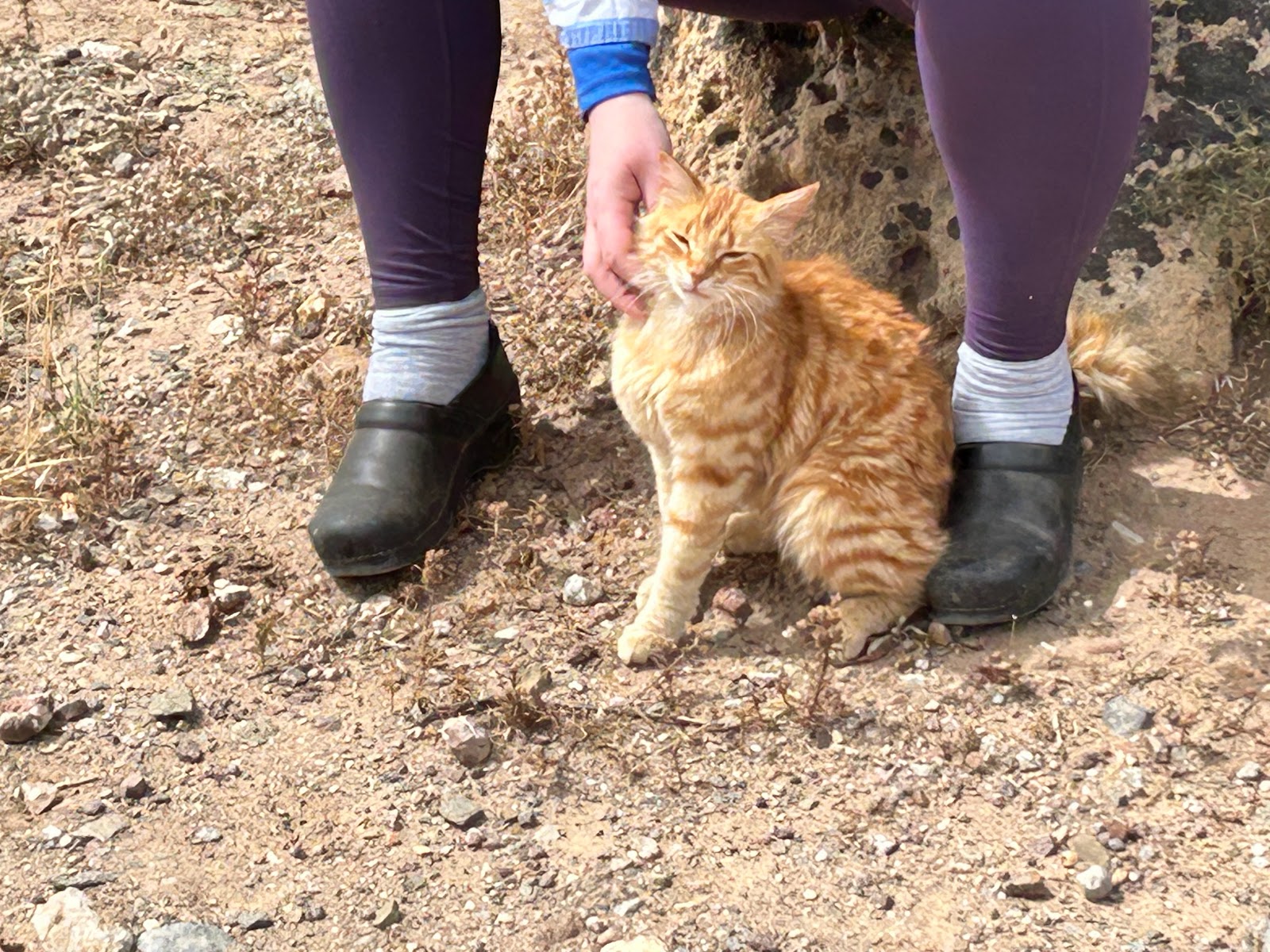
We did, however, get to meet a lovely cat on site

who was extremely happy to make Lauren's acquaintance.


Friday, May 12, 2023

Travel report: Getting to Crete

Gratuitous cats photo

 We made it to Heraklion, Crete in a notably simple fashion. The flight to Athens went through Heathrow, but that wasn’t a problem as our friend Chuck had just gotten a promotion after waiting years for it and wanted us to stop by and see his new office chair (he called it a ‘throne’, but that’s just what he’s like).  Anyway, we were just there for a few hours before catching the flight to Athens. 

A short (and cheap - €5.50/ea) bus ride brought us to Syntagma Square, itself a 5 minute walk to our AirBnB (these work well in Greece, we’ve found).  The next night we caught the overnight ferry to Heraklion - leaves at 9pm, gets in at 6:30am. For €125, we got a swanky cabin with a real bathroom and shower, nice bed, and was able to sleep all the way over. Great way to arrive in Crete. 

My favorite bit was the car rental. I was originally trying to find a car with Hertz/Budget/SIXT - the big names. None of them were willing to rent me a car at their Port locations when we got in at 6:30; you had to wait until they opened at 8am and then take whatever cars they had. So I ended up going with a local Cretan firm. They met us at the port itself when the ship got in with the car - the firm’s co-owner herself. She gave us restaurant recommendations, parking suggestions, and pointed out sites to see on a map she gave us (this latter bit wasn’t entirely necessary, as you can tell from Lauren’s posts, but nice nonetheless).  Plus the car rental for a week, including full damage insurance (which they required) was only €280. Great deal all around. 

No photos of any of this, so I added a gratuitous action-cat photo  


Thursday, May 11, 2023

Gratuitous Photos of the Acropolis

We haven't been to too many new and photogenic sites yet, so to tide you over, here are some new shots of and around the Acropolis.  I'll photoshop out the people and scaffolding later.  Still, it is hard not to be in awe of these monuments in any form.  


Theatre of Dionysos

The Erechtheion

The Porch of the Caryatids


Propylea

Steps inside the Propylaea

Temple of Athena Nike

North Side of the Parthenon (and part of the Erechtheion)

East Side of the Parthenon

West Side of the Parthenon


FYI, you can walk along the south side of the Parthenon, but the reconstruction offices and the signs discussion the history of the reconstruction largely obstruct the view from that angle (you can see it from the rooftops), so here is an amusing visual commentary of an employee "restoring" the restoration offices on the South Side

.
Also, because the Caryatids on the porch are replicas, here are the 5 of the actual statues relocated to the Acropolis Museum.


Ask me to show you pictures from other angles for others details in the clothing/draping and that each Caryatid has a unique braid!


Quote of the Day

After sipping some tsipouro at dinner, and with a grainy exhalation, I noted, "you can really taste that secondary processing."


Just for a little more context, we had ordered a bottle of house red wine, which we had come to expect was a locally produced vintage, usually by the proprietors or a relative of the restaurant.  This was "Vin du Crete", and came chilled.  We really did know better, especially since we will be imminently discussing Cretan wines, but we drank it anyway.  So, by the end of the meal, the wine had already done its job that this 45% ABV spirit was, perhaps, unnecessary.  


Snails, Snails, Snails!

In Crete, we have encountered a number of unusual new industries, which appear to be commonplace.  Snail farming is one such example.  No, we haven't gone to one (yet), but I'm not sure it is necessary.  While visiting Tylissos, we saw thousands, making my unrealized Buddhist sensitivities cringe with the potential implications of each step.

So, this will be an ongoing post of "animals in unusual places".  Here, I give you, snails on an archaeological site.

First contact.  This was the first shell I spotted, and had it not been inhabited, it might have been a souvenir.  We'll call him Bob.

Practicing a tightrope act.

Ornamenting some wild rosemary.

Yep.  No idea what the motivation is here.

Two parties on an ancient wall.

I also learned that the collective noun for a group of snails can be either a rout, a walk or an escargatoire.  I think I shall embrace the last as it sounds like they are about to meet their ultimate purpose as part of a traditional Cretan dish.

UPDATE!!!  More snails, this time on a tree trunk!


Flagrant Uses of Marble (Part 2)

On our first trip, I was amused at the near ubiquitous use of marble in some completely unexpected applications.  I remember the first time we walked to the Acropolis that the street and sidewalks were paved in marble, and that there were even parking lane lines of white versus the grey/striated.  Here are some other examples:

One of at least 2 dozen new benches atop the Acropolis.

Stanchion bases

A fence (in front of a Roman cistern)

Curbing.

Sidewalk.  
I found this one particularly amusing since this is clearly a sidewalk replacement of concrete blocks.  Upgrading the marble!

Road construction.  The gutters are grey, while the general paving is white (in the crates).

I've also seen marble used as counters at the ticket booths for everything, but ONLY the counter.  The rest of the structure can be some wood hut, but with a marble counter.